Unveiling the Future of Privacy in Machine Learning: The RMIA Breakthrough
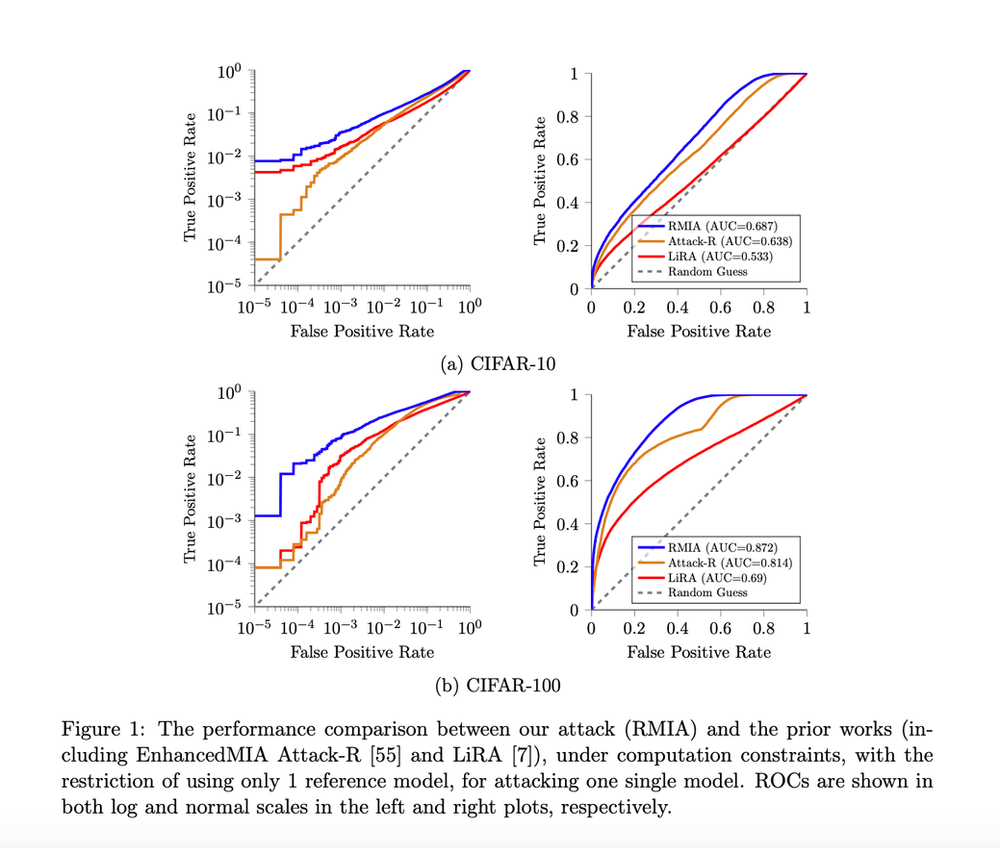
Privacy concerns in machine learning have reached a pivotal juncture with research from the National University of Singapore. The team introduced a technique called the Relative Membership Inference Attack, or RMIA, designed to change how privacy risk is analysed in machine learning models.
Why RMIA was needed
Membership inference attacks have become a critical focal point in evaluating the unintended exposure of information during model training. Conventional approaches, while effective, faced real problems: heavy computational demand, and no clear means of comparing one attack against another. The need for something more robust and more efficient is what produced RMIA.
The methodology
RMIA constructs two distinct worlds, one where a specific data point x is a member of the training set and one where it is not. Unlike prior methods it composes the null hypothesis carefully, leading to pairwise likelihood ratio tests that gauge x's membership relative to other data points. The method computes a likelihood ratio distinguishing the member and non-member scenarios, offering a more nuanced analysis of leakage.
Leveraging population data
RMIA leverages population data and reference models to improve both attack potency and robustness against variations in adversary background knowledge. Through a refined likelihood ratio test it measures the distinguishability between x and any z based on shifts in their probabilities when conditioned on the model. This calibrated approach avoids depending on uncalibrated magnitude, which is where earlier methods became unreliable.
Performance
The authors compared RMIA against other membership inference attacks across CIFAR-10, CIFAR-100, CINIC-10 and Purchase-100. RMIA consistently outperformed, particularly with a limited number of reference models or in offline scenarios. It stayed reliable with fewer models, and with abundant reference models it held a slight edge in AUC and notably higher true positive rate at zero false positive rate.
Practical implications
RMIA excels at identifying membership within machine learning models, and its efficiency, flexibility and scalability make it viable for privacy risk analysis in settings where resources are constrained. The balanced trade-off between accuracy and false positives makes it a dependable choice.
The governance value here is straightforward. Privacy risk in a trained model has usually been argued rather than measured, because measuring it was too expensive. When the measurement gets cheap, it can become a control in an assurance process rather than a research exercise.
This is a summary and interpretation of the research paper. Read the full paper on arXiv.